Why are football fan content creators influenced by toxic culture?
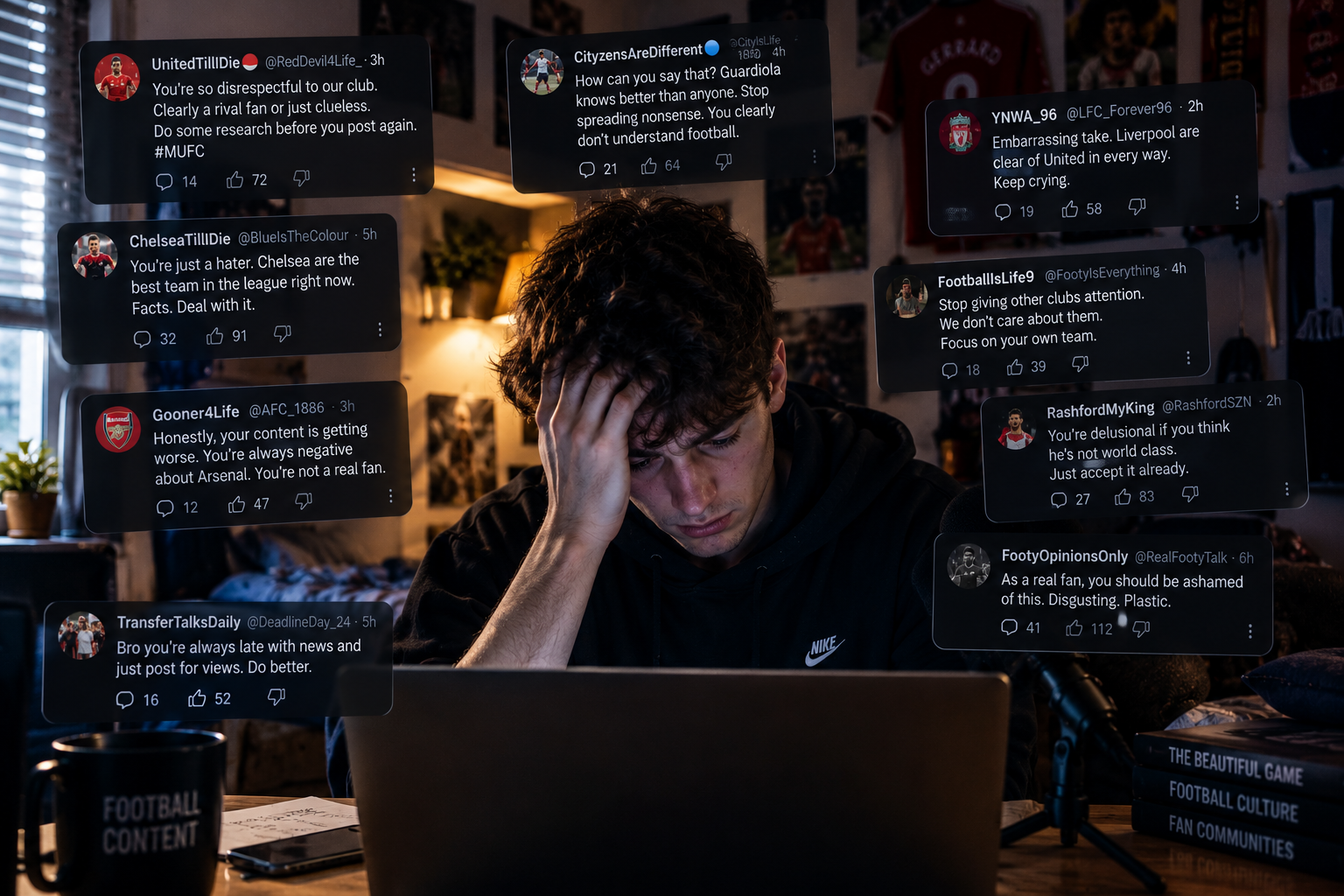
Photo credit: ChatGPT
Football, we know it as the beautiful game, is a great sport watched and consumed by many national and global fans worldwide.
The backing that the fandom displays for one’s supported side can be filled with happiness, unity and positivity especially if their team have fought to win the game or seals the most crucial three points. On the other end, there is disappointment.
Fan popularity across social media continues to grow and develop in the football world itself, as the new demographics being introduced are adjusting to new digital media they have never used before.
What about the fans who dedicate their lives to producing media covering elite football clubs?
Ever since the early 2010s, football content has been on the rise. Known fan channels like AFTV, The Football Terrace and The United Stand have transformed the consumption of short and long-form content to target diverse audiences.
The problem that arises digitally on social media is fan toxicity.
Arsenal fan and co-host of YouTube channel Orest Talks Football Mani Thangadurai gives his views on why some football fan creators have become toxic in the world of sports media coverage.
“When it comes to content creation, controversy sells, anger sells. If you take a look at some of these watch-alongs that people do, they don't even commentate on the action, said Thangadurai.
“Whenever I do some, I try to go into commentator mode. I realised that's not necessarily going to get that much in terms of traction, because people like to see people getting angry and loud on the internet.
On football channels, Thangadurai said “The problem is, because these channels are now so well established, you are going to get some more subscribers and followers in. So, it's out with a few, in with a few more.
“And that's also what's, in many ways, affected a great deal of channels. It's given them some popularity in the short term, but in the long term, some people will start to move away from that.
According to a report by Fair Game, it is estimated that around 83% of football figures and participants have experienced a negative wellbeing due to abuse online.
Abuse and constant hatred can be shown on many platforms in the evolving football industry where all fans have the ability to communicate their opinions and perspectives.
As per a study by Dublin University School of Communications Assistant Professor Colm Kearns, their findings reveal that some regular fans get triggered by abuse against them, impacting one’s wellbeing online.
X, owned by Tesla co-founder Elon Musk, is one of the current toxic platforms for football supporters.
Head of Football Media for Redditch United, and Wolverhampton Wanderers supporter, Jack Underwood says emerging football content creators need to ignore the outside noise of criticism to publish their content.
“I think people go into it knowing I'm going to get some sort of abuse or toxicity, said Underwood.
“Number one, you can just ignore it. You can block, delete. If you're trying to grow your channel, it's actually better to leave comments in because more comments means the algorithm pushes out your content more.
“The other thing you can do is learn from it. If someone's saying ‘this isn't good, you could do this better’ - that's not necessarily toxicity. Alternatively, if they disagree with something, that's just their opinion.
“Most of the time it is to generate an argument because then people in the comments reply to share their opinions.”
Is there a balance to minimise toxicity in fandom?
Excluding the negative side of sports media, there are football creators who show positive attributes to encourage compelling media content.
Thangadurai, who contributes to X and co-hosts Orest Talk Football, believes that fan creators who want to collaborate with other fans can inspire community integration and unbiased content.
“I actually work with a Bournemouth fan channel called Up the Cherries In All Departments, said Thangadurai.
“it's a wonderful story because my old friend, Stephen Featley, Lord rest his soul, actually hosted Craig Beasley from UTCIAD for one of his shows.
“Stephen was an avid sports fan content creator who was passionate about football and F1. We had met on another content creator’s stream.
“He got in touch with me, and we had been working together since then until his tragic death. And it was through his channel that I got to meet Craig.
“There are several other clubs where you find the content creators are nowhere near as toxic as the ones associated with big clubs. None of the toxicity, none of the animosity. And it's just a lot nicer that way.”
In the landscape of social media, discussions have been happening between different sets of fans to share how toxicity should be managed.
Jack Underwood goes on to explain if the negativity will change. “I think it will always be there. I wouldn't say we're getting worse because a lot of social media brands are now introducing things like filtered comments.
“That is what pushes media content. It's how people become big and how they get big channels because they generate arguments and controversial topics.”
Thangadurai also shares ideas on fixing the toxicity issue: “I think one of the best ways it can happen is if more people start to become content creators, but they also feel a bit more confident in the quality of their own creation, also have a good, strong network of friends supporting them.
“If you have more people creating content and not being toxic, you are going to see more from the usual suspects that are too loud and obnoxious and arrogant.”
As we are approaching towards the end of 2026, toxic football fan creation is amongst one of the most talked about debates across different fanbases in football.
More effective strategies need to be implemented by those in power to maintain balanced sports media coverage. The elements of toxicity need to be minimised.